
Blog
Classroom table and chair heights by year level

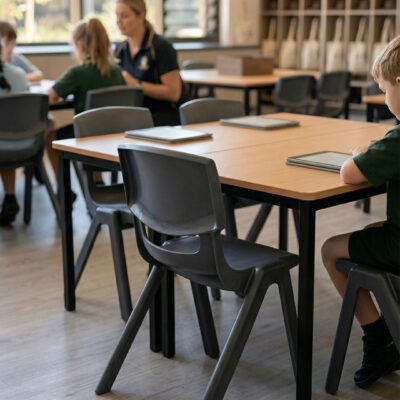
Furniture that does not fit the student causes more problems than it looks like it should. A chair that is too tall leaves feet dangling, which pushes weight forward and makes sitting still harder. A table that is too high lifts the shoulders. Over a school day, that becomes fidgeting, poor handwriting posture and complaints of discomfort.
The basic relationship
Two measurements matter and they work together. Seat height should let a student sit with feet flat on the floor and knees at roughly a right angle. Table height should let the forearms rest level, with the elbows at about the same height as the table top.
Getting one right and the other wrong does not work. A correctly sized chair at an oversized table still lifts the shoulders.
Mixed cohorts are the real problem
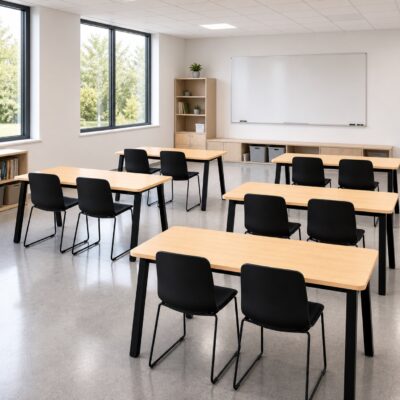
The difficulty in most schools is not choosing a size, it is that one room serves several year levels across a week, or that a single class spans a wide range of heights. This is where fixed-height furniture forces a compromise.
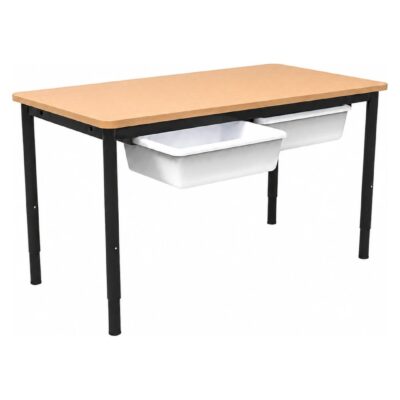
Height-adjustable tables cover a range of year levels from one purchase, which is why they suit shared rooms, specialist spaces and inclusive classrooms. They cost more per table, so the sensible approach is usually a mix: adjustable where the room is shared, fixed where a room stays with one cohort.
Practical checks
Sit a student at the setting before committing to a large order. Look for flat feet, level forearms and a relaxed shoulder line. If you are furnishing a whole school, take measurements from a few real students per year level rather than working from a chart alone.
Browse classroom tables and student chairs, or talk to us about tailored pricing for bulk orders.










 Education Seating
 Student Chairs
 Computer
 Stools
 Ottomans
 Modular
 Booths
 Outdoor Seating
 Auditorium
 Benches
 Tables & Desks
 Classroom Tables
 Collaborative
 High Tables & Benches
 Teachers Tables & Desks
 Folding & Flip Tables
 Meeting Tables
 Carrells
 Student Storage
 Lockers
 Bag and tote storage
 Shelving & Cupboards
 Trolleys
 Visual & Display
 Whiteboards
 Pinboards
 Mobile Whiteboards
 Partitions
 Accessories
 Table Tops
 Locker Accessories
 Seating
 Ergonomic Chairs
 Visitor Chairs
 Task Chairs
 Lounge & Tub Chairs
 Executive
 Training Room
 Stools
 Desks
Desks Returns
 Straight Desk
 Sit-Stand
 Corner Desk
 Executive Desks
 Modesty Panels
 Workstations
 Luna
Luna Boost
Boost Halo
Halo Deluxe Infinity
 Rapid Span
 Eternity
 Rapid Worker
 Screens
 Tables
 Meeting Tables
 High Tables & Benches
 Side Tables
 Storage
 Bookcases
 Drawers & Pedestals
 Cupboards & Wall Units
 Filing Cabinets
 Hutch
Hutch Hobs & Pigeon Hole Units
 Desk Accessories
 Monitor Arms
 Cable Baskets & Trays
 Charging Modules
 Standing Mats
 Outdoor
 Collaborative
 Breakout
 Reception
 Library
 Library Fitout
 Shelving
 Reading Lounges
 Staffroom
 STEM
STEM STEM Benches & Tables